










Scouts from all over the Bay Area used Camp Dimond for many purposes. In April of 1927, a Patrol Leaders Conference was held at Dimond for both the Oakland Council and the San Francisco Council. The Oakland Board of Education had a very close relationship with the Scouts and would rent Camp Dimond on many occasions for meetings and teacher retreats.
From 1933 until 1949, the council headquarters of the Oakland Area Council was located at Camp Dimond in the former first aid building that was known as the Camp Kiwanis building. By the 1940’s over 3000 Scouts would be using Camp Dimond throughout the year for their various outings, functions, meetings, Court of Honors and Father-Son dinners. In 1943, the mortgage note to Camp Dimond was paid off making the camp fully owned by the Oakland Council.
BOARD OF EDUCATION SEEKS TO CONDEMN DIMOND
As the population of Oakland grew so did the need for additional schools. This was especially true in the hills of Montclair where new house construction was creating the need for two new schools. The residents of Oakland saw this need and passed a $15M bond measure in 1945 which also included money for the construction of new schools. When the bond measure passed, the Oakland Board of Education started looking at various sites in the hill area for the location of a new school but kept coming back to the land that the Boys Scouts owned. The site of Camp Dimond was centrally located, was accessible by bus, had enough acreage and for the most part was level. Everything the Board of Education needed, except that they did not own the land.
In October of 1947 the Oakland Board of Education in a letter to the executive board of the Oakland Area Council indicated that they required the Camp Dimond property and would take any necessary steps to acquire the land. At the time Scout Executive Homer Bemiss indicated he would not stand in the way of the Board of Education. However in a letter of response from the Oakland Executive Board to the Board of Education their response was a resounding No.
Also working against the Scouts was the fact that the City of Oakland was improving the streets and adding sewer lines to that area of town. The Dimond property had approximately 3000 feet of frontage along the streets to be upgraded. The City of Oakland would assess a value to the Scouts based on the amount of street frontage as well as the connection fee to the new sewer lines. These fees alone would run into the thousands of dollars.
The city of Oakland and the Oakland Board of Education started the condemnation process to condemn the property in order to take possession of the Scout property. The Oakland Area Council did not have the power to stop this condemnation process and ultimately had to sell the property to the Oakland Public Schools in 1948.
LETTER TO THE EDITOR OF THE OAKLAND TRIBUNE - December 13, 1947
“We the Scouts and leaders of Troop 54 of Crocker Highlands School, are opposed to the action of the Board of Education in ordering condemnation proceeding to take our Scout Camp from us. Many of us as well as our parents and friends contributed generously four years ago to pay off the mortgage of the camp so that the camp may be enjoyed by the Scouts and the Cub Scouts of Oakland. If this camp with all its facilities including the swimming pool, craft shop, nature den, cooking areas, cabins, amphitheater and mess hall are taken away from us, the scout program in Oakland will never be the same. Most of the Scout program is built around the camp from which Scouts and Scout Leaders from all over Oakland can reach in a very short time by automobile, bus, by streetcar or by hiking.
We feel that the overwhelming majority of Scouts, Scout leaders and all citizens of Oakland feel the same way and that we believe that everyone should have the opportunity to express their view so Camp Dimond can be saved for the Scouts and future Scouts. Let the Board of Education select another site for their proposed school.”
CAMP DIMOND CLOSES
On August 10, 1948 at the end of its regular summer camping season and 29 years after it opened, Camp Dimond closed its doors forever to camping. The mess hall though would still be used for another six months for meetings and scout gatherings until it was torn down in early 1949. The office of the Oakland Council which was located in the Camp Kiwanis building remained in place until June, but the process of closing Dimond for good had started. The equipment and supplies from Dimond were moved into temporary storage at Camp Shoemaker on the grounds of Camp Parks in Dublin as well as Camp Meek in San Lorenzo.
In January of 1949 the 5200 square foot mess hall and each of the twenty-one Scout Cabins built in 1923 by the Troops, the Rotary Club and the Kiwanis Club were put up for sale for any perspective buyer. However before the Mess Hall was torn down, the properties committee used the interior of the building to construct forms for the new pool up at Los Mochos. On March 1, 1949 the Oakland Public Schools took physical possession of Camp Dimond from the Boy Scouts and in June grading began as the former camp site was cleared and flattened in preparation for the two new schools. Two years after Camp Dimond closed, Joaquin Miller Elementary school would open its’ doors in September of 1950 on the grounds of the former camp leaving only Dimond-O as the sole summer camp for the Oakland Area Council. Starting in May of 1949, the Oakland Public Schools provided the Scouts with some temporary space at the Garfield Elementary School that was used as the Council Office until a permanent space could be located for the Scouts.
CAMP DIMOND REMNANTS
Although Camp Dimond has been gone for over sixty years, portions of the camp can still be found today with a little investigation. The giant sand filter tanks that once ensured clean water for the 300,000 gallon round swimming pool was moved up to Los Mochos in 1949 where it filtered the Los Mochos pool until 2012. The Camp Kiwanis building which was used as the first aid building and then as the Council Office from 1933 until 1949 was cut into three sections and moved up to Los Mochos for use as the Ranger’s cabin.
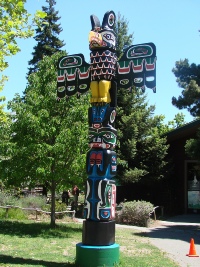
In 1953 the Lake Merritt Nature Center was built through funds donated by the Oakland Rotary Club and a memorial fund in honor of Oakland Area Council Naturalist Brython “Bugs” Cain. Inside the Nature Center are some of BC Cain’s Camp Dimond bug collection that were once located in the famed nature hut, also known as the “Bug House”, The collection was first moved to the former Camp Meek property in San Lorenzo and eventually the collection was moved to the Lake Merritt nature center. A totem pole very similar in appearance to the the large Camp Dimond totem poles built by Ed Taylor in the 1930’s is located at the entrance to the Nature Center. Although built by a modern day craftsman, the pole harks back to the years when Ed carved the poles at Dimond.
In the summer of 2008, I had the opportunity to explore the old camp grounds of Dimond and was able to find a few areas of the camp that still remained. The cement piers that once supported the back deck of the amphitheater stage are still in place on the hillside, although massive trees were now growing between their columns. A section of the stage as well as portions of the Indian Village could still be found including pieces of a metal cot, overgrown power lines in the trees and a rusted tank that may have been used for water storage.